
5 Things Behavioral Health Agencies Must Know Before Enrolling with a New Insurance Payer
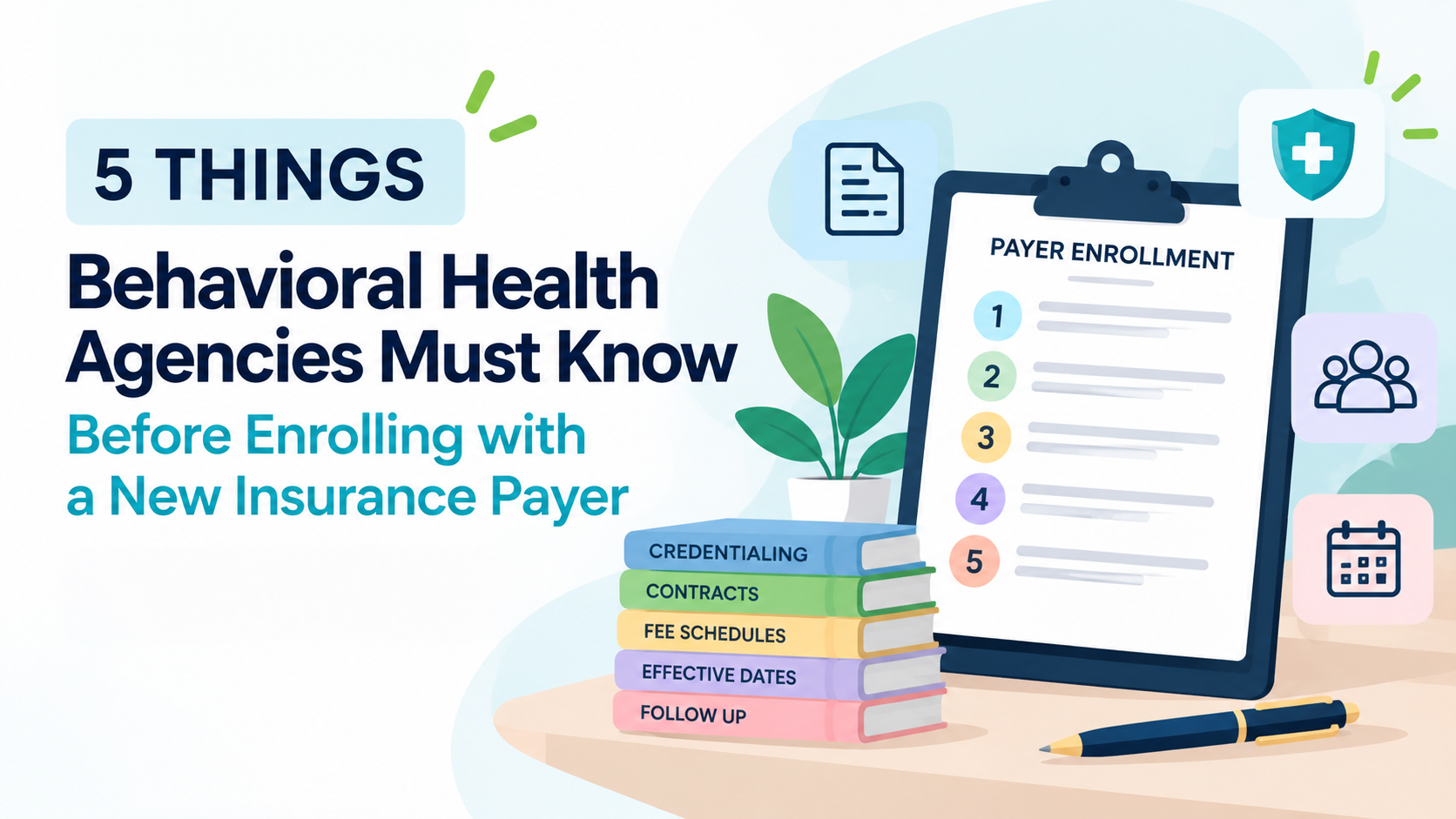
You hire a great new clinician, they start seeing clients within a week, and everyone’s excited about the growth. Then a few weeks later, billing discovers the provider was never actually loaded into the payer’s system, and every claim tied to those early sessions is rejecting, denying, or sitting in limbo. Now payroll is due, and the money you were counting on isn’t there yet.
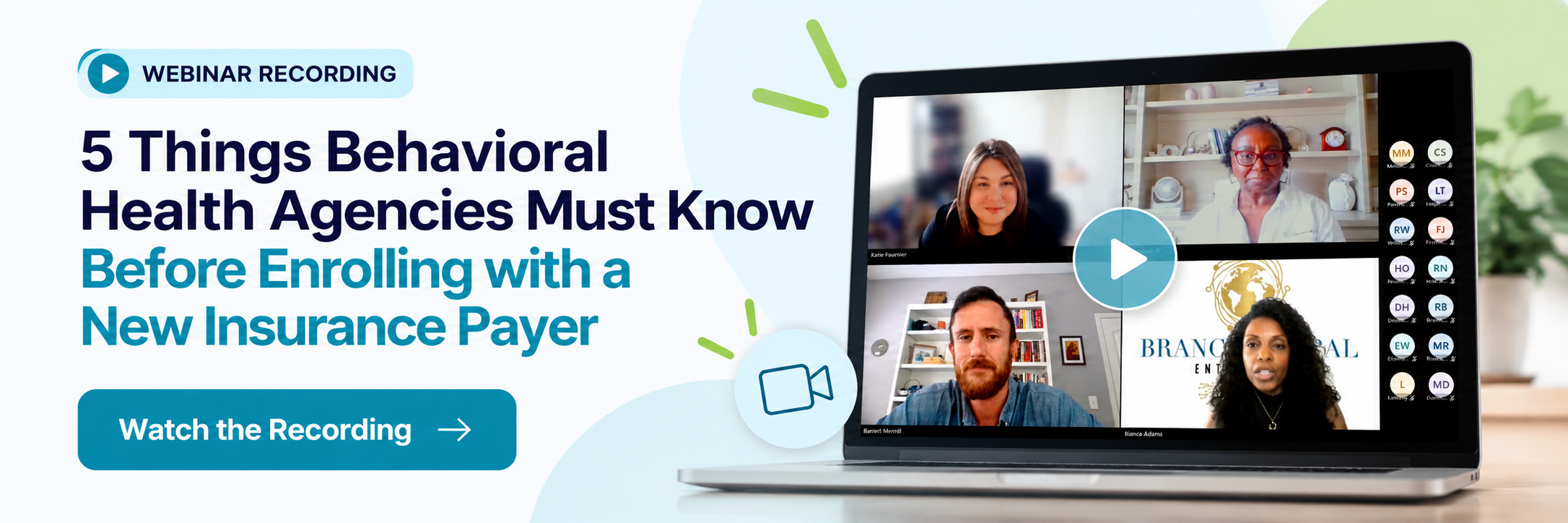
That scenario is so common it has a name in revenue cycle circles, and it’s almost always preventable. We recently hosted a webinar with Bianca Adams, CEO of Branch Global Enterprises and a credentialing and revenue cycle specialist with 13 years of experience across nine states, who walked through exactly what agencies get wrong. Here’s what she covered.
1. Credentialing, contracting, enrollment, and activation are four different things
This is the mistake Adams sees most: agencies treat “getting set up with a payer” as one step, when it’s actually four, and each one can stall independently.
Credentialing is the payer verifying the provider’s qualifications — education, license, work history, malpractice coverage, any sanctions. Contracting is the participation agreement itself: which network, what reimbursement rate, what’s covered. Enrollment is a separate step where the provider and group information actually gets loaded into the payer’s internal system — Adams has seen providers fully credentialed and contracted who were never loaded, meaning every claim denies as “not enrolled” despite a signed agreement in hand. And activation is about the effective date: when the contract was signed doesn’t tell you when you can actually bill and expect reimbursement.
Confusing these steps is how agencies end up billing for a date of service the payer will never pay for — because as Adams put it, insurers essentially never retroactively pay for services provided before the effective date.
2. Get your data clean before you apply
Before submitting anything, agencies need one legal practice name that matches exactly across every document: IRS paperwork, Secretary of State registration, and the voided check on file. Adams named this the single most common mistake she sees — an LLC listed one way on IRS records and another way everywhere else, which triggers rejections and delays before the application even gets reviewed.
Beyond the legal name, have this ready before you start: individual and group NPI numbers, tax ID, a current W-9, license and malpractice documentation, practice and billing addresses, banking information, and CAQH login credentials with the practice location already loaded. Missing any one of these doesn’t stop the process — it just delays it, often by weeks.
3. CAQH has to be complete and attested, not just started
A lot of providers assume having a CAQH profile is the same as being enrolled with a payer. It isn’t — CAQH is a shared data repository that payers pull from, not an enrollment system itself, and having an incomplete or unattested profile is one of the most common silent causes of a stalled application.
Attestation has to happen on a recurring cycle (roughly every 120 days for most states), and payers do periodically audit these profiles. If your address is out of date and you miss the notice, your status can lapse without anyone on your team noticing until claims start denying.
4. Track every application until it’s fully active
Submitting an application is the beginning of the process, not the end. Adams was blunt about this: if your credentialing tracking lives only in someone’s email inbox, you don’t actually have a tracking system.
A real tracker should show, for every application: the provider’s name, the payer, submission date, current status, last follow-up date, next follow-up date, the payer’s reference number, and copies of the signed contract and fee schedule. Payers will often quote a processing window like 60 days — that’s not permission to wait 60 days before checking in. Adams recommends following up weekly, and specifically early mornings on Thursdays or Fridays, since that’s when she’s found payers are most responsive.
5. Confirm enrollment actually supports billing before you submit claims
Being “enrolled” on paper doesn’t automatically mean your billing team can bill correctly. Before the first claim goes out, verify: the effective date, that the provider is linked to the correct group and tax ID (not a different location’s tax ID, which sends payment to the wrong entity entirely), that the correct practice location shows on file, and that portal access, ERA (electronic remittance advice), and EFT (electronic funds transfer) are all set up. It’s also worth confirming which specific products a provider participates in — HMO, PPO, POS, EAP — since enrollment with one doesn’t guarantee enrollment with all of them under the same payer.
The common thread
Every mistake on this list traces back to the same root cause: treating payer enrollment as paperwork instead of the first stage of your revenue cycle. A credentialing gap doesn’t stay contained to credentialing — it becomes a billing problem, then a payroll problem, then a client-trust problem when someone gets an unexpected bill because their provider turned out to be out of network.
The fix isn’t complicated, even if it takes discipline: start enrollment the day you hire (or even at the offer-letter stage), keep one shared tracker instead of relying on memory or email, and verify — don’t assume — that everything lines up before you bill.
If claim denials tied to enrollment or eligibility issues are already showing up in your data, our Denial Decoder tool can help you trace exactly which denial codes are coming from enrollment gaps versus other issues.
Sources
- Bianca Adams, CEO, Branch Global Enterprises — presented via Checkpoint EHR webinar, “The 5 Most Important Things to Know When Enrolling with a New Insurance Payer”
- CAQH, Provider Data Portal Resources
- Centers for Medicare & Medicaid Services, NPPES NPI Registry
- Centers for Medicare & Medicaid Services, Medicaid Provider Enrollment Requirements Fact Sheet