
What Medicaid Work Requirements Mean for Your Agency Starting January 1, 2027
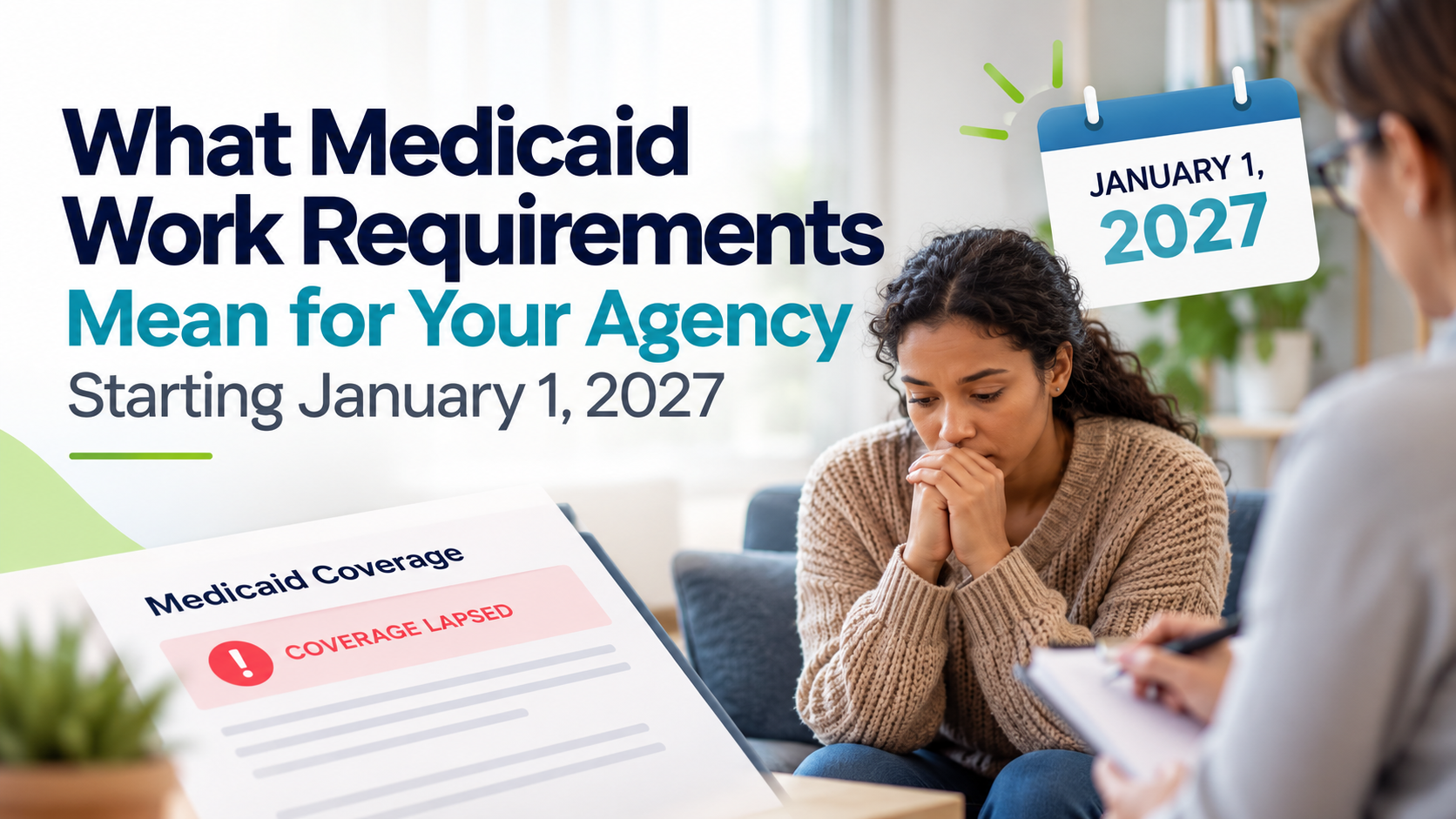
Picture a client who’s been in weekly treatment with you for months, making real progress, fully covered by Medicaid the entire time. Then one day their coverage lapses — not because anything changed clinically, but because a new paperwork requirement caught them off guard and nobody flagged it in time. That’s the scenario Medicaid behavioral health agencies need to start preparing for now, not next year.
Starting January 1, 2027, most states must begin enforcing new federal Medicaid work requirements. Some are moving even faster. And while your clients with a substance use disorder or a disabling mental health condition are supposed to be exempt, “supposed to be” is doing a lot of work in that sentence — and the exemption isn’t automatic.
What’s actually changing
Under an interim final rule CMS issued in June 2026, most Medicaid expansion adults ages 19 to 64 will need to document at least 80 hours a month of qualifying activity — employment, job training, community service, or at least part-time enrollment in education — to keep their coverage. This is often called a “community engagement requirement,” and it applies to the Medicaid expansion population in the 40 states (plus D.C.) that expanded coverage under the ACA.
The federal deadline for states to have this in place is January 1, 2027. But several states aren’t waiting: Nebraska began enforcement in May 2026, Montana and Arkansas started in July 2026, and Iowa is set to begin in December 2026. If your agency operates across state lines, you’re not looking at one deadline — you’re looking at several, and they’re not aligned.
The exemption that matters most to you
Here’s the part that should get behavioral health leaders’ attention specifically: individuals with a substance use disorder or a disabling mental health condition fall under what CMS calls the “medically frail” exemption, along with people who are blind, disabled, or living with a serious or complex medical condition. In theory, that means a meaningful share of your client base won’t be subject to the 80-hour requirement at all.
In practice, CMS has been clear that a diagnosis alone doesn’t automatically qualify someone. The agency’s interpretation requires that the condition significantly impair the person’s ability to actually meet the requirement — and clients need to provide proof of diagnosis to claim the exemption in the first place. That puts your documentation practices in an unusually direct line to your clients’ coverage continuity. A treatment record that clearly establishes a diagnosis and its functional impact isn’t just good clinical practice anymore — it’s what stands between a client and a coverage gap.
States are also moving away from simple self-attestation. Under the new rule, they’re expected to verify work-requirement compliance (and, by extension, exemption status) using existing data sources — payroll records, Medicaid payment and encounter data — before asking individuals for additional documentation. That’s a reason for cautious optimism, but it also means your agency’s own records may end up being part of the data trail states rely on.
What this looks like operationally
A few things are worth doing well before your state’s deadline hits, whatever that date turns out to be:
- Identify at-risk clients now. Cross-reference your active caseload against the expansion population your state covers, and flag clients whose exemption status isn’t clearly documented.
- Tighten your documentation for exemption-qualifying conditions. Make sure substance use disorder and disabling mental health diagnoses are clearly recorded, along with functional impact — not just a diagnosis code sitting in the chart.
- Increase eligibility verification frequency. With coverage now at risk from two directions — six-month redeterminations and work requirement compliance — checking eligibility at intake alone is no longer sufficient for longer treatment episodes.
- Track your specific state’s timeline separately from the federal deadline. A multi-state agency needs a state-by-state calendar here, not a single date on the wall calendar.
None of this is about compliance for its own sake. A client who loses coverage mid-treatment because of a missed exemption or an outdated address on file is a client whose care gets disrupted and whose sessions may go unpaid. Both outcomes are avoidable with enough lead time.
The scale of what’s at stake
This isn’t a small provision. Congressional Budget Office estimates tied to the community engagement requirement specifically have put annual coverage losses in the range of several million people nationally, concentrated among exactly the population — adults on Medicaid expansion coverage — that many outpatient behavioral health agencies serve heavily. Even a modest share of your caseload losing coverage unexpectedly can create a real cash flow problem on top of the disruption to care.
Staying ahead of a moving target
The hardest part of this particular change isn’t any single rule — it’s that the rules are landing differently by state and on different timelines, while CMS guidance continues to evolve. An agency that treats this as a “check back in December” issue is going to be reacting under pressure. An agency that builds the identification and documentation habits now has months of runway to get it right.
If you want to stay current as your state’s specific requirements and deadlines take shape, our Medicaid Monitor tracks state and federal Medicaid policy changes like this one as they develop, so you’re not finding out about a deadline the week it hits.
Sources
- Centers for Medicare & Medicaid Services, Medicaid Community Engagement Requirement Interim Final Rule
- KFF, Implications of Medicaid Work and Reporting Requirements for Adults with Mental Health or Substance Use Disorders
- Congressional Budget Office, Supplemental Cost Estimate: Medicaid Provisions
- Commonwealth Fund, How Will States Implement the Behavioral Health Exemption to Medicaid Work Requirements?