
What 2026 Medicaid Reimbursement Changes Mean for Your Agency’s Budget
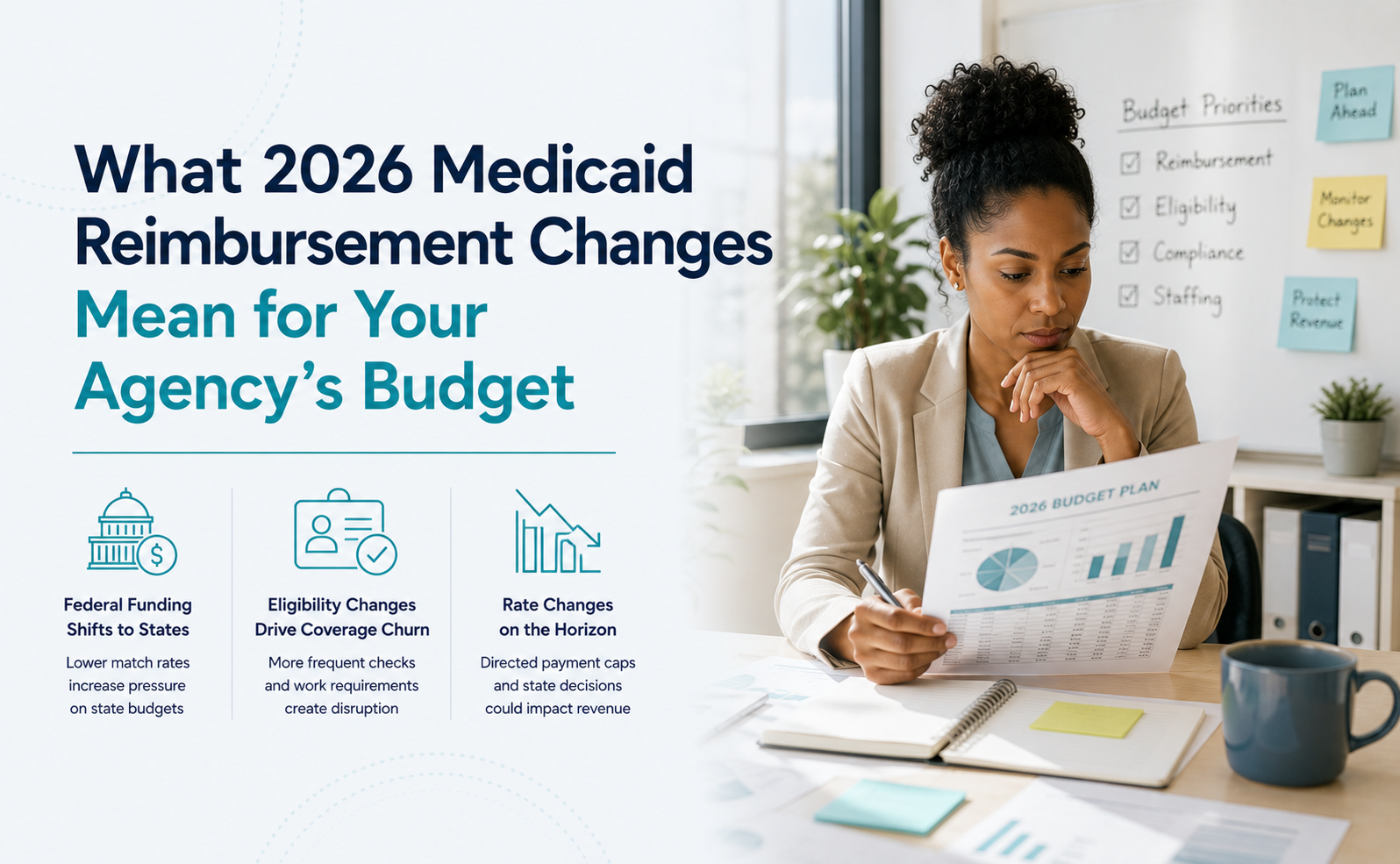
If next year’s budget feels harder to pin down than usual, it’s not just you. Between federal funding changes, new eligibility rules, and proposed shifts to how states pay Medicaid providers, there’s more moving at once right now than most behavioral health leaders have had to plan around in years.
None of this means panic. It does mean that the agencies walking into 2027 with a clear read on what’s changing — and what isn’t — will be in a much better position than the ones caught off guard mid-year.
The big one: federal funding is shifting to states
The reconciliation law known as H.R. 1 (widely referred to as the OBBBA), signed in mid-2025, reduces the enhanced federal match rate for Medicaid expansion populations from 90% down to 80%, phased in starting federal fiscal year 2027. The Congressional Budget Office’s own analysis of this kind of match-rate reduction lays out the basic mechanism: less federal money means state governments have to make up the difference, and they generally do it through some combination of raising revenue, cutting benefits, or reducing what they pay providers.
KFF’s state-by-state modeling puts the added cost to expansion states at billions of dollars a year once the phase-down is fully in effect. That’s the pressure that eventually reaches your agency, usually as a rate freeze, a new prior authorization requirement, or a tightened benefit definition — not as a single dramatic announcement, but as a series of smaller state-level decisions over the next few years.
What’s actually protected
It’s not all bad news, and it’s worth knowing where you stand. Behavioral health and substance use disorder services were specifically exempted from the new Medicaid cost-sharing requirements that apply to other service categories under the same law. That’s a meaningful signal that behavioral health carved out some protection in a bill that cut deeply elsewhere — but it doesn’t mean your state’s reimbursement rates are protected from the broader budget pressure described above. Those are two different mechanisms, and it’s easy to conflate them.
Coverage churn is about to get more disruptive
Two changes are going to affect how consistently your clients stay covered, which matters as much to your revenue as the rate itself:
- Six-month eligibility redeterminations begin at the end of 2026, roughly doubling the frequency of the eligibility checks that can knock someone off Medicaid.
- Work requirements (sometimes called community engagement requirements) take effect federally on July 31, 2026, with states required to implement by January 1, 2027. Several states are moving faster — Nebraska started enforcement in May 2026, and Montana and Arkansas began in July.
The practical risk isn’t philosophical, it’s operational: a client covered at intake may lose coverage mid-treatment episode, and services delivered during that gap are far more likely to end up denied. This is especially disruptive for longer or more intensive levels of care, where an episode of treatment can easily span a redetermination cycle.
A proposed change worth watching closely
If your organization benefits from a state directed payment arrangement — the supplemental payment mechanism many states use to bring Medicaid managed care rates closer to commercial levels — pay attention to a CMS proposed rule released in May 2026. It would cap those payments at 100% of Medicare rates in expansion states and 110% in non-expansion states, replacing a more generous benchmark tied to commercial rates. For agencies in states that lean on these arrangements, this could be one of the more consequential rate changes in this entire package. Medicaid.gov’s guidance page on state directed payments is the best place to track how your state responds as this moves from proposed to final.
What this means for your 2026–2027 budget
Build next year’s projections with more conservative rate assumptions than usual, and don’t assume last year’s reimbursement environment holds steady. Tighten your eligibility verification cadence given how much more often coverage can lapse now — checking at intake alone is no longer enough for longer treatment episodes. And keep an eye on your state Medicaid agency’s bulletins specifically, since a lot of this plays out state by state rather than through a single federal announcement.
It’s also a good moment to make sure your documentation and billing processes have as little slack in them as possible. When reimbursement is under pressure everywhere else, a clean, error-free claim becomes even more valuable — there’s simply less room to absorb avoidable denials on top of everything else that’s shifting.
The bigger picture
This isn’t a one-time update you read and file away. Medicaid policy is moving in real time right now, at both the federal and state level, and the agencies that stay ahead of it protect their revenue and their ability to serve clients without the kind of budget surprises that force reactive decisions.
If you want ongoing updates as these changes move from proposed to final, our Medicaid Monitor tracks exactly this kind of policy shift as it develops.
Sources
- Congressional Budget Office, Reduce Federal Medicaid Matching Rates
- KFF, Eliminating the Medicaid Expansion Federal Match Rate: State-by-State Estimates
- Centers for Medicare & Medicaid Services, Medicaid Community Engagement Requirement Interim Final Rule
- Centers for Medicare & Medicaid Services, Medicaid Managed Care State Directed Payments Proposed Rule
- Medicaid.gov, State Directed Payments Guidance