
Why Clean Claim Rates Drop as Medicaid Behavioral Health Agencies Scale Past 20 Staff
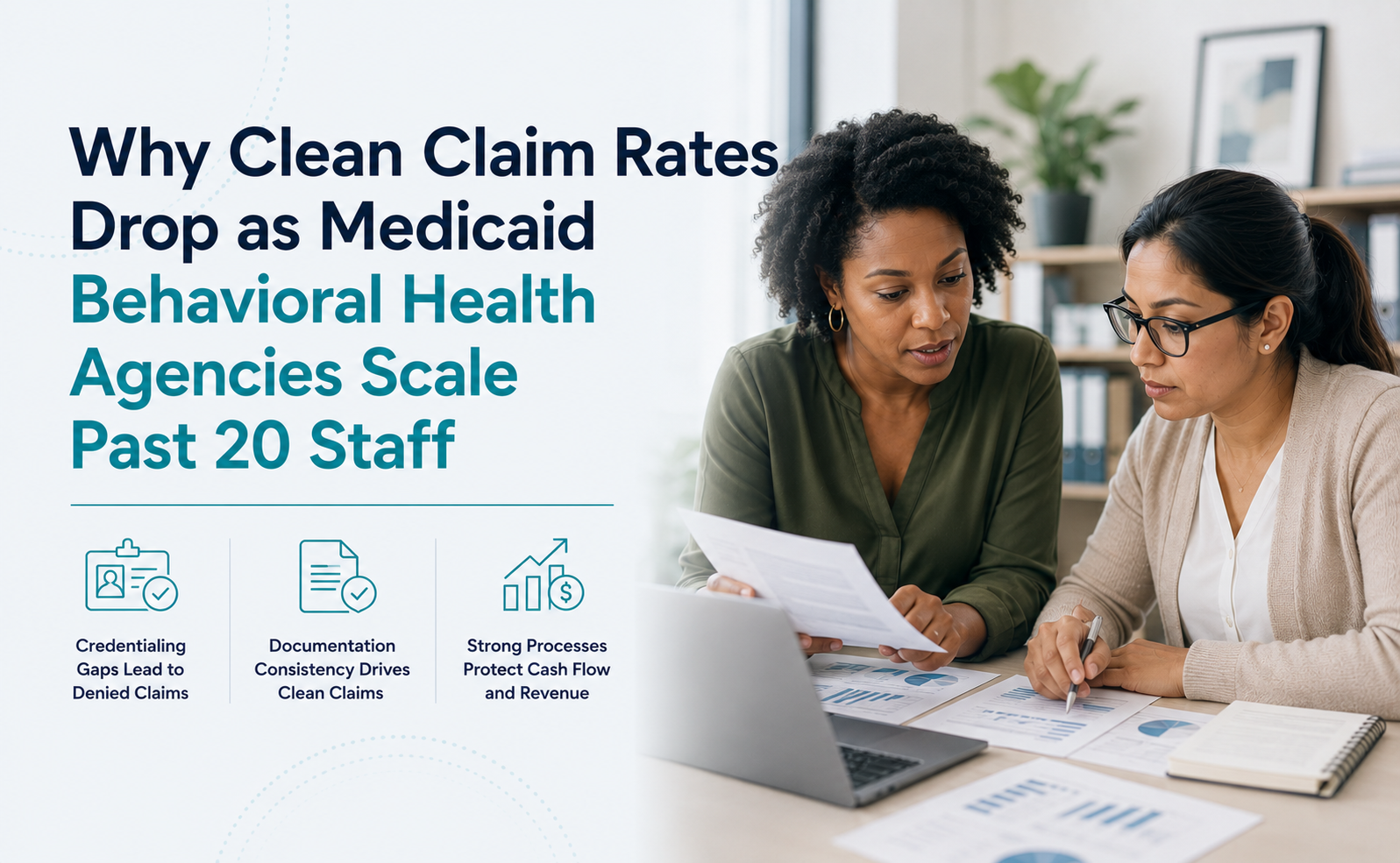
If your billing process ran smoothly at 12 clinicians and started falling apart somewhere around 25, you’re not imagining it, and you didn’t suddenly get worse at running your organization. Something structural changes when a Medicaid-focused behavioral health agency crosses that growth threshold, and clean claim rates are usually the first place it shows up.
It’s a frustrating pattern because nothing looks obviously broken. The same billing software, mostly the same process, similar payer mix — and yet denials creep up, days in accounts receivable stretch out, and someone on your team is spending more of their week chasing rejected claims than they used to.
What “clean claim” actually means, and why it matters for cash flow
A clean claim is one that can be processed without your billing team or the state having to go back and get more information — no missing data, no authorization gap, nothing under review. Federal Medicaid regulations at 42 CFR § 447.45 require state Medicaid agencies to pay 90% of clean claims within 30 days and 99% within 90 days.
That’s a meaningful guarantee, but it only applies to claims that are actually clean. Anything that gets kicked back for missing information, an expired authorization, or a credentialing mismatch falls outside those timelines entirely, and starts the clock over once it’s corrected and resubmitted. Your clean claim rate isn’t just a quality metric — it’s the difference between predictable cash flow and a revenue cycle that’s constantly playing catch-up.
Why growth is the thing that breaks it
At a smaller size, one or two people usually understand the entire billing process end to end. They know which payers are picky about which fields, they catch a missing authorization before it goes out the door, and they’ve built enough informal checks to keep the clean claim rate high without anyone calling it a “system.”
That informal system doesn’t scale. A few specific things tend to break as an organization grows past the 20-staff mark:
- Credentialing lag. New clinicians start seeing clients before their Medicaid enrollment is fully approved, and every claim tied to that gap gets held or denied until enrollment catches up.
- Documentation inconsistency. More clinicians means more variation in how notes get written and how quickly, and billing can only submit a clean claim if the documentation behind it actually supports the code.
- Payer mix complexity. Growing agencies add contracts and service lines faster than their billing processes adapt, and a workflow built for two payers doesn’t hold up cleanly across six.
- No single owner. Below a certain size, revenue cycle oversight is often informal — everyone pitches in. Past that size, without someone dedicated to owning it, small errors compound faster than anyone notices them.
None of these are staff failures. They’re the predictable result of a process that was never redesigned for the scale the organization grew into.
The cost is bigger than it looks
It’s easy to treat a slipping clean claim rate as a minor operational annoyance. The numbers say otherwise. CMS’s Fiscal Year 2025 Improper Payments Fact Sheet put the national Medicaid improper payment rate at 6.12% — and notably, more than three-quarters of those improper payments were traced back to insufficient documentation, not fraud or abuse.
That statistic matters here because it confirms what shows up constantly in growing behavioral health agencies: the gap between a clean claim and a denied one is overwhelmingly a documentation and process problem, not a bad-actor problem. It’s exactly the kind of gap that widens as an organization scales faster than its systems do. We’ve written before about the most common reasons Medicaid claims get rejected or denied — worth a look if you want the tactical, claim-by-claim version of this problem.
Fixing it before it compounds further
The agencies that keep their clean claim rate stable through growth tend to do a few things deliberately, rather than hoping the informal system holds up:
They build a credentialing tracker that flags exactly when a new hire is cleared to bill each payer, instead of relying on someone remembering to check. They standardize documentation expectations across clinicians — not to make notes generic, but to make sure every note supports the code being billed. And they give revenue cycle oversight to someone specific, whether that’s a dedicated billing manager or part of a broader operations leadership role, so gaps get caught by design rather than by accident.
That last point connects to something we covered in our last post on bringing in non-clinical leadership: a lot of the revenue cycle problems that show up past 20 staff are really ownership problems. Someone needs to be responsible for the system, not just the individual claims moving through it.
The bigger picture
A dropping clean claim rate isn’t just a billing inconvenience — it’s a preview of how the rest of your operations will handle growth if nothing changes. Agencies that get ahead of it protect their cash flow, reduce the daily stress on their billing team, and build a revenue cycle that can actually support the size they’re growing into, instead of constantly bracing for the next wave of denials.
If you want to see exactly where your denials are coming from, our Denial Decoder tool breaks down your rejection patterns so you know what to fix first.
Sources
- Code of Federal Regulations, 42 CFR § 447.45 – Timely Claims Payment
- Centers for Medicare & Medicaid Services, Fiscal Year 2025 Improper Payments Fact Sheet
- Centers for Medicare & Medicaid Services, Payment Error Rate Measurement (PERM) Program
- National Council for Mental Wellbeing, thenationalcouncil.org